
Skip to content
  • Projects
  • Publications
  • News
  • About us
    • Our team
    • PhD students
    • Eriksholm’s timeline
    • History of hearing aids
    • Partnerships
    • Contact us
  • Projects
  • Publications
  • News
  • About us
    • Our team
    • PhD students
    • Eriksholm’s timeline
    • History of hearing aids
    • Partnerships
    • Contact us
  • Projects
  • Publications
  • News
  • About us
    • Our team
    • PhD students
    • Eriksholm’s timeline
    • History of hearing aids
    • Partnerships
    • Contact us
  • Projects
  • Publications
  • News
  • About us
    • Our team
    • PhD students
    • Eriksholm’s timeline
    • History of hearing aids
    • Partnerships
    • Contact us
Back

Neural Correlates of Speech Understanding 

Emina Alickovic

Principal Scientist

Eriksholm Research Centre

Dorothea Wendt

Principal Scientist

Eriksholm Research Centre

Neural Correlates of Speech Understanding 

Introduction

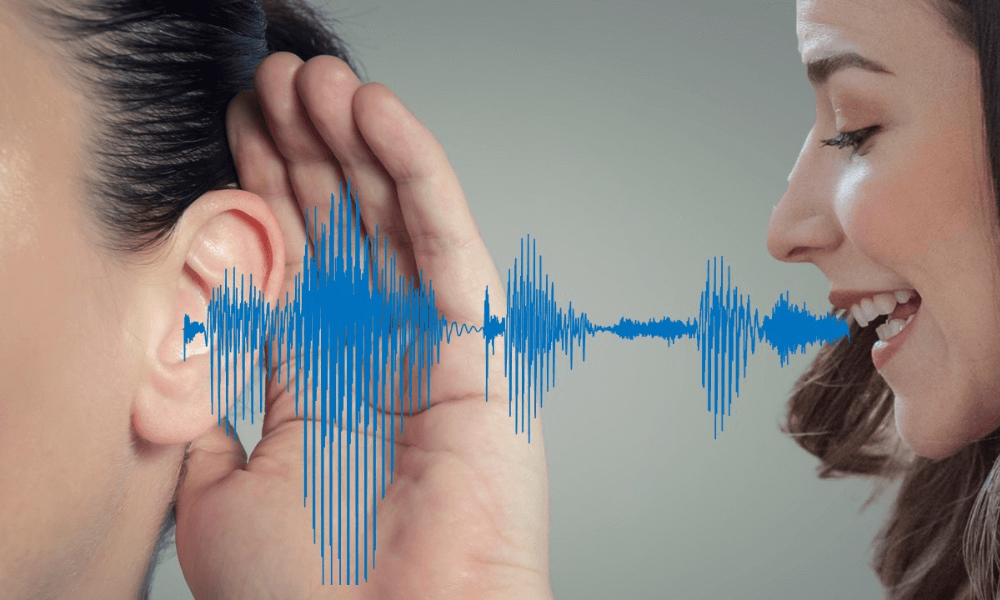
Try to picture yourself with your friends and family. You are at a restaurant, surrounded by other people enjoying their time there as well. You are chatting with your friends when your cousin joins in. The conversation changes between topics, like food or amusing stories, and you effortlessly follow along, shifting attention between them so that you can follow the conversation. This is enjoyable for most, but those with hearing problems find it challenging. They struggle to switch their attention between speakers, making conversations in noisy places like this difficult to follow.

Aims

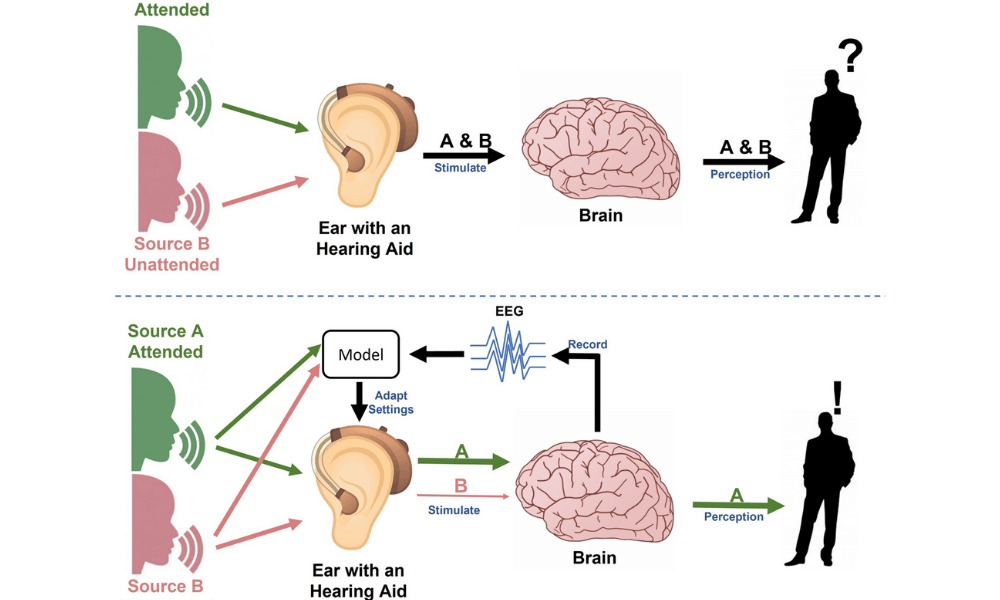
In our earlier research, we have shown that hearing aids (HAs) can help the brain by making relevant sounds louder and reducing background noise. Now, we want to understand if the brain not only registers the relevant sounds but also comprehends these. We’re studying how the brain processes language, at increasing levels of abstraction – from individual speech sounds, words, and sentences to meaning. By understanding this comprehension process, we hope to help people with hearing problems understand speech better, especially in noisy places. Our goal is to improve interventions like hearing aids, making it easier for users to grasp language amidst noise. This would greatly improve their social interactions.

Methodology

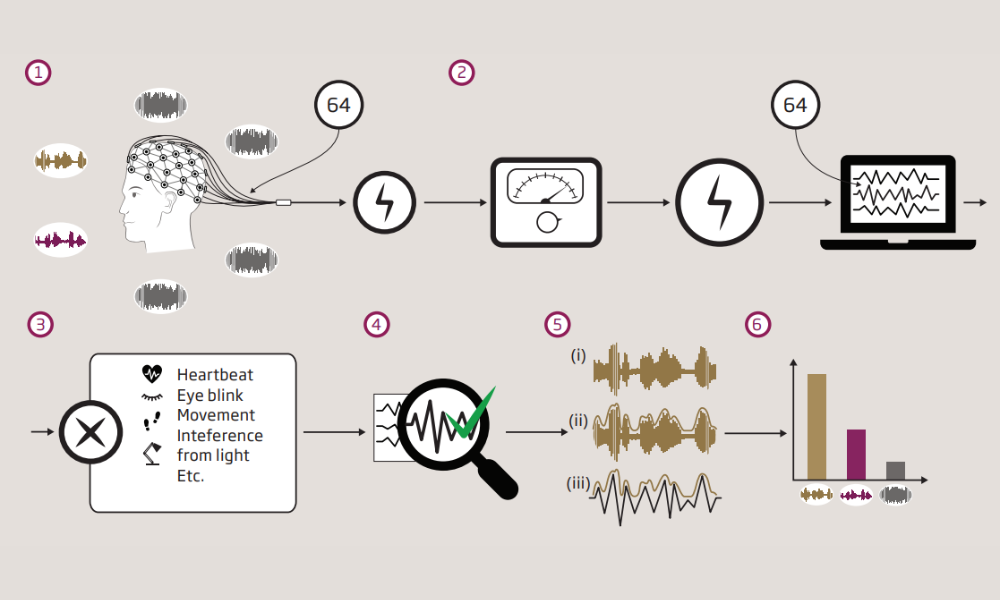
We are developing advanced computational methods called neural speech tracking. This method uses a special brain measurement technique EEG to record the brain’s electrical activity. EEG lets us observe how the brain signals track and understand different speakers. These methods can explain how different language elements are processed in the brain. They allow us to take a closer, more detailed look at the neural representation of speech. This detailed view of neural speech tracking offers a better understanding of language processing, ultimately making social interactions more pleasant for everyone, including those with hearing challenges. 

Publications

Loading...
Borges, H. B., Zaar, J., Alickovic, E., Christensen, C. B., & Kidmose, P. (2024). Speech-reception-threshold estimation via EEG-based continuous speech envelope reconstruction. bioRxiv (Cold Spring Harbor Laboratory). https://doi.org/10.1101/2024.06.26.600765

Team

Emina Alickovic

Principal Scientist

Eriksholm Research Centre

Dorothea Wendt

Principal Scientist

Eriksholm Research Centre

Kasper Eskelund 

Senior Researcher

Oticon A/S

Florine Bachmann

Scientist

Eriksholm Research Centre

Simon With

Research Audiologist

Eriksholm Research Centre

Thomas Ulrich Christiansen

Scientist

Eriksholm Research Centre

View all

You may also be interested in

Loading...
Neural Correlates of Speech Intelligibility 
CURRENT
Neural Correlates of Speech Intelligibility 
7795,4341,4335

Cognitive Hearing Science, Personalised Audiology

Speech intelligibility describes how well listeners can understand and repeat back speech items, usu...
Speech intelligibility describes how well listeners can understand and repeat back speech items, usually short…
Neural measures of Selective Auditory Attention for Assessment of Hearing Aid Technology 
CURRENT
Neural measures of Selective Auditory Attention for Assessment of Hearing Aid Technology 
4335,3008

Cognitive Hearing Science, Artificial Intelligence (AI)

Selective auditory attention is crucial for effective speech communication and social interaction in...
Selective auditory attention is crucial for effective speech communication and social interaction in complex sound…
New EEG-based Source Localization Methods for Investigating the Neural Basis of Speech Processing
CURRENT
New EEG-based Source Localization Methods for Investigating the Neural Basis of Speech Processing
4335,4398

Cognitive Hearing Science, Artificial Intelligence (AI)

Electroencephalogram (EEG) is a non-invasive brain technique that objectively measures electrical ac...
Electroencephalogram (EEG) is a non-invasive brain technique that objectively measures electrical activity in the brain…
Optimizing Level-Dependent Auditory Brainstem Responses to continuous speech
CURRENT
Optimizing Level-Dependent Auditory Brainstem Responses to continuous speech
4335,1037,8022

Personalised Audiology

Auditory brainstem responses (ABRs) are typically obtained by averaging EEG reactions to repeated tr...
Auditory brainstem responses (ABRs) are typically obtained by averaging EEG reactions to repeated transient stimuli,…
Speech ABR: clinically-useful brainstem responses to continuous speech
CURRENT
Speech ABR: clinically-useful brainstem responses to continuous speech
14000,1037,4335

Personalised Audiology

Auditory brainstem responses are small electrical signals generated in the ‘reptilian’ early par...
Auditory brainstem responses are small electrical signals generated in the ‘reptilian’ early part of the…

You may also be interested in

Neural Correlates of Speech Intelligibility 
CURRENT
Neural Correlates of Speech Intelligibility 
7795,4341,4335

Cognitive Hearing Science, Personalised Audiology

Speech intelligibility describes how well listeners can understand and repeat back speech items, usu...
Speech intelligibility describes how well listeners can understand and repeat back speech items, usually short…
Neural measures of Selective Auditory Attention for Assessment of Hearing Aid Technology 
CURRENT
Neural measures of Selective Auditory Attention for Assessment of Hearing Aid Technology 
4335,3008

Cognitive Hearing Science, Artificial Intelligence (AI)

Selective auditory attention is crucial for effective speech communication and social interaction in...
Selective auditory attention is crucial for effective speech communication and social interaction in complex sound…
New EEG-based Source Localization Methods for Investigating the Neural Basis of Speech Processing
CURRENT
New EEG-based Source Localization Methods for Investigating the Neural Basis of Speech Processing
4335,4398

Cognitive Hearing Science, Artificial Intelligence (AI)

Electroencephalogram (EEG) is a non-invasive brain technique that objectively measures electrical ac...
Electroencephalogram (EEG) is a non-invasive brain technique that objectively measures electrical activity in the brain…
Optimizing Level-Dependent Auditory Brainstem Responses to continuous speech
CURRENT
Optimizing Level-Dependent Auditory Brainstem Responses to continuous speech
4335,1037,8022

Personalised Audiology

Auditory brainstem responses (ABRs) are typically obtained by averaging EEG reactions to repeated tr...
Auditory brainstem responses (ABRs) are typically obtained by averaging EEG reactions to repeated transient stimuli,…
Speech ABR: clinically-useful brainstem responses to continuous speech
CURRENT
Speech ABR: clinically-useful brainstem responses to continuous speech
14000,1037,4335

Personalised Audiology

Auditory brainstem responses are small electrical signals generated in the ‘reptilian’ early par...
Auditory brainstem responses are small electrical signals generated in the ‘reptilian’ early part of the…

People are our most
valuable source of
insights

Facebook

Instagram

LinkedIn

Youtube

  • Eriksholm Research Centre
  • Rørtangvej 20
  • DK-3070 Snekkersten
  • Denmark
We are a part of Oticon, a world leader in hearing care. We share the same philosophy that people are our main source of insights
Bliv testperson
  • +45 48 29 89 00
  • mail@eriksholm.com
  • Cookie policy
  • Disclaimer

© 2025 Eriksholm – Designed by Aveo web&marketing

Manage consent to cookies
We use cookies to optimize our website and our service.
Functional Always active
The technical storage or access is strictly necessary for the legitimate purpose of enabling the use of a specific service expressly requested by the subscriber or user, or solely for the purpose of transmitting a communication via an electronic communication network.
Preferences
The technical storage or access is necessary for the legitimate purpose of storing preferences that are not requested by the subscriber or user.
Statistics
The technical storage or access used exclusively for statistical purposes. The technical storage or access that is used exclusively for anonymous statistical purposes. Without a subpoena, voluntary compliance on the part of your Internet Service Provider, or additional records from a third party, information stored or retrieved for this purpose alone cannot usually be used to identify you.
Marketing
The technical storage or access is necessary to create user profiles for the purpose of sending advertisements or to track the user on a website or across multiple websites for similar marketing purposes.
  • Manage options
  • Manage services
  • Manage {vendor_count} vendors
  • Read more about these purposes
Preferences
  • {title}
  • {title}
  • {title}